Thursday, 6 November 2014

Section 1: Purpose of interviews

There are many different reasons why Media professionals conduct interviews, addressing many different ideas and subjects in a formal or informal way depending on the purpose and intention. Including different people from famous to non famous backgrounds,  political or for entertainment. There are many different interviews co-ordinated together for many different reasons in the Media industry.

  
One style of interview I am looking at is entertainment. In this example of an American Tv show 'On the tonight show'. A pop celebrity Miley Cyrus is being interviewed by Host of the show Jay Leno. This Celebraty is being interviewed about her career and personal life on the show.  Giving her audience like her fans insight in her life and letting others know more about her.  They also include different kinds of games and activities on the show to provide the entrainment for the audience. Another reason why celebrities or people in the Media eye come onto talk shows is to promote a certian album,
or product they are brining out. This advertise's the celebrity and their products, which gain's more sales for them but they also gain more views and more notice from the audience that watches the talk shows. Comparing this interview to 'The art of the interview' podcast it shows all positive aspects of creating a informational and successful interview. For example Jay Leno has a script that he is reading off of to make sure the interview goes as smoothly as it can. The median for this interview is first placed on T.V on the 30th January 2014. It then was streamed online and can be seen on YouTube on the 'On The Tonights Show' YouTube channel, on the Tonights show website.                                                                                            

 Another style of an interview is a informational interview. Here is a hard /light hearted political interview with Russell Brand on 'BBC news night'. I believe this because of the light tone that they are both are using when answering each others questions, although they start to become heated, Paxman's body language is very casual and laid back when talking, which is unusual compared to other interviews he has been involved in. Jeremy Paxman the interviewer in this clip is asking Russell brand many different open questions to hear his opinions on politics. Reasons they conduct an informational interview is to present information, in this case his views on politics and to give an audience information about Russell Brand's political article and his views as a comedian on politics and the government today. It helps Russell Brand promote and share that he is the quest editor of a political magazine 'NewStatesman' and has written a very detail article of his views, was called 'We no longer have the luxury of tradition', which Paxman shares as a 'Revolution'.  The median that this interview would first be placed on would be on T.V on 'BBC news night'  it then would be streamed online on websites like youtube, Vimeo, BBC website and others. Listening to some of the points from 'The art of the interview' I picked up some points that they included in Russell Brands interview with Paxman. For example Paxman used the rule of three, asking a direct question three times so the interviewee gets frustrated and answers the question without heading it into another direction 'Why don't you vote', which is a question that Paxman used. He is also interviewing someone who is passionate and is taking responsibility for what he is saying, which was also mentioned in the podcast to conduct a successful interview.
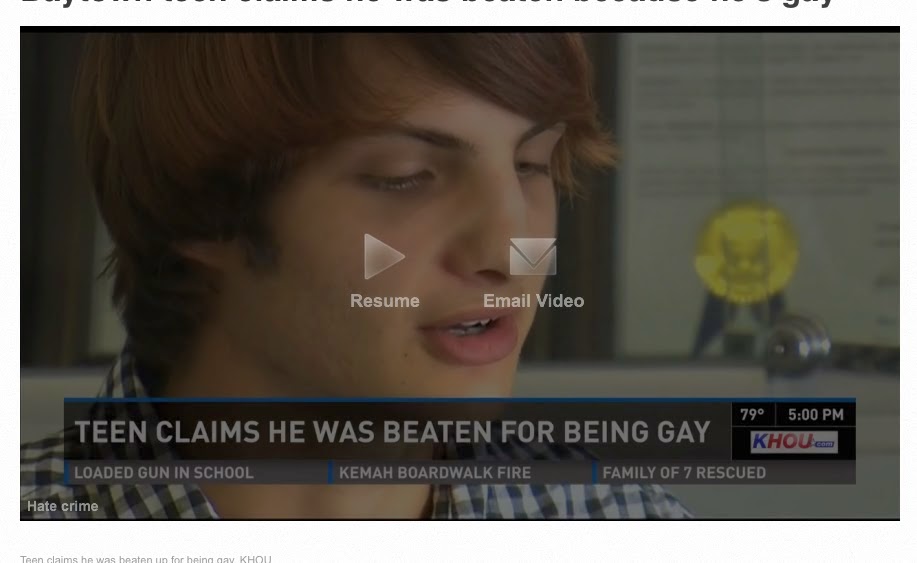
  
Here is another style of an interview, called an emotional interview. This is when someone is being interviews because something upsetting or violent happened to them. An interviewer would ask questions about how they feel about the situation and want them to explain what happened to them. In this interview, which is taking place on 'KHOU.com', which is a web interview they are talking to a young man that shares his story of being attached by his friends because of his sexuality. This is a very light hearted interview because they are talking to someone who is sharing something difficult they have felt with. Because they are explaining, open questions would be used to let them share their story 'What did you do when they started calling you names?'. This is allowing the audience to have an insight to the situation. also for others to use this information and to create a campaign for children being build for people finding it hard to deal with their sexuality. giving them palace to go to if they are dealing with the same problem.  The median of this Interview is online, which is a page from the website 'KHOU.com' this could have been streamed from T.V. Again listening to the video there is a few points that this interview did well according to the video. They are interviewing someone who is directly involved int he event that is happening instead of getting someone who is an outsider from the situation. 

Wednesday, 5 November 2014

Section 3: Definitions of interview techniques


Question types:
-Open question: A question, which cannot be answered with a yes or no, as it requires detail, for a person to explain what they mean.
-Closed question: A question, which does not need a long answer, and can answer with a yes or no, or even a short phrase, which is quick an easy to answer.
-Single: Single is where only one type of question is asked to the interviewee.
-Multiple: A question, which involves one or more questions when asking the interviewee expecting more then one answer.
-Direct: A question, which is straight to the point.
-Suggestive: A question, which infers a specific answer.

Interview styling:
-Hard news: An interview that is short, fast paced news that usually appears on the front page of newspapers.
-Combative: An interview, which is considered to be aggressive towards the interviewee. Someone who is eager to fight and argue about a point.
-Light hearted: An interview, in which is done is a relaxed and casual manner, in order to make the interviewee comfortable.
-Entertainment: An interview that is for entertainment when interviewing a celebrity or someone recent in the public eye.
-Investigate: An interview that aims to discover what is happening in a certain event. By asking questions to get out facts and more in depth information.
-Promotional: An interview, that purposefully promotes someone or something, for example an album or a product they are bringing out.


Introduction development question:
-Confidence building: This is were the interviewer uses techniques in order to develop and build the interviewee's confidence, as result the interviewee’s feel relaxed and may let out more information then planned.
-Key questions: An important question which the interviewer wants to ask the interviewee to gain certain knowledge.
-Soundbites: A short clip, which summarizes the context and main point of an issue or an event.
-Summary: summing up all thats has been said in an interview, putting together a conclusion. 
-Windup:


Communication skills
-Building rapport: A skill used by the interviewer in order to gain the interviewee's trust.
-Active listening: This is where the interviewer takes in what the interviewee has to say in order to be able develop new questions from the information they have received also to calm and keep the interviewee in a calm mood.
-Body language: Body language allows the interviewer to see if the interviewee is engaged and shows different emotions and feelings of the interviewee.

Telephone techniques
-Gathering information:
-Obtaining comments:

Friday, 12 September 2014

Task 3 - Analyse the artist

The Artist's song that I will he using as my music video track is Rudimental. Rudimental has different genres that their music comes under, including Pop, Drum and bass, Soul ect. When listening to the genre that one of their songs come under, the music videos that are played I think, do not meet the genre exactly. For example 'Feeling the love' genre is shown to be Drum and bass. Rudimental use disjunctive music videos which could give a hidden meaning to the song/ feeling/ lyrics of the song.

Rudimental use this disjunctive method for most if not all of their music videos. Another example would be the song that I have chosen 'Waiting all night' featuring Ella Eyre. This song falls under the genre drum and bass and also liquid funk. Again the music that is played does not fit in with the narrative/ lyrics, but could be a hidden meaning with the lyrics as well as the narrative.

The style that Rudimental have, looking at different pictures is very London urban. Because Rudimental are not shown/ present in their music videos, we cannot really see what they wear.

Most of Rudimental's Music videos do not contain the band themselves, their style for there music videos is to use a disjunctive video, or a real life story without having themselves present within.


In this video 'feel the love' shows the disjunctive narrative and how the band is not featured in their music videos.

How this example shows the disjunctive narrative is the lyrics that are being played and repeated are 'I gotta tell you' as a guy is riding a horse around in the snow. A visual that will match with the lyrics would be someone lip syncing the words to another character or a visual of a character telling another character a secret or certain information that links with the rest of the music video and the lyrics.


The song that i am going to be doing a music video for is 'Waiting all night'  by Rudimental FT Ella Eyre.  Looking at this music video, the main creative concept for this video is a man who's hobby is to ride BMX bikes, then gets into a car collision, which follows with him having to get his leg amputated. Throughout the video it shows his struggles of changing his life to fit around having one leg. It also shows his struggles to get back to what he likes doing the most. The video is full of hand held personal footage of friends trying to regain his spirits and be supportive in his recovery and getting back to normality.

Wednesday, 10 September 2014

Task 4 - Analyse the track

"Waiting All Night"
(feat. Ella Eyre)

I've been waiting all night for you to
Tell me what you want, tell me, tell me that you need me
I've been waiting all night for you to
Oh, oh, tell me what you want yeah    
I've been waiting all night for you to
Tell me what you want, tell me, tell me that you need me
I've been waiting all night for you to
Oh, oh, tell me what you want yeah
Want yeah, want yeah, want yeah, want yeah
Want, want, want, want, want, want, want, want

I've been waiting all night for you to tell me
Tell me that you need me
Tell me that you want me
I've been waiting all night for you to tell me
Tell me that you need me
Tell me that you want me

Tell me that you need me
Tell me that you want me
Tell me that you need me
Tell me that you want me

Tell me that you need me
Tell me that you want me
Tell me that you need me
Tell me that you want me
Oh!

I've been waiting all night for you to
Tell me what you want, tell me, tell me that you need me
I've been waiting all night for you to
Oh, oh, tell me what you want yeah
I've been waiting all night for you to
Tell me what you want, tell me, tell me that you need me
I've been waiting all night for you to
Oh, oh, tell me what you want yeah

I've been waiting all night for you to tell me
Tell me that you need me
Tell me that you want me
I've been waiting all night for you to tell me
Tell me that you need me
Tell me that you want me

Tell me that you need me
Tell me that you want me
Tell me that you need me
Tell me that you want me

Tell me that you need me
Tell me that you want me
Tell me that you need me
Tell me that you want me
Oh!

Uh, yeah, tell me right now
Tell me, tell me right now

Tell me that you need me
Tell me that you want me
Tell me that you need me
Tell me that you want me

Tell me that you need me
Tell me that you want me
Tell me that you need me
Tell me that you want me
Oh!

Music video with introduction is 5:13
Music video without introduction is 4:53
Throughout the song the pace changes, in the start the pace is very slow but sill upbeat through the first verse of the song leading up to the chorus of the song. I then slows down into the second verse still keeping upbeat. pace becoming faster when reaching chorus again. 

There are different meanings that different people can take to the song. The meaning i have taken and what i think this song could mean is a girl/boy is in a relationship with another, wanting them to admit or show there affection for the other. wanting them to under std how the other is important and whats them to let them now before they go off in separate ways. 

The main content of this song that is show throughout with repeated lyrics is love/ lust wanting to be loved or lusted over but shown in desperate way by the way the same lyrics are repeated and very forward and straight to the point. This is shown by the lyrics 'I've been waiting all night for you to tell me, tell me that you want me'. 

The imagery of the lyrics are low, again because of the repeated lyrics. what i can see is a desperate person, anting to know the feeling of someone they love so they can understand if the feeling is mutual. 

Again there is no set narrative for this song because of the small amount of lyrics that are shown. 


Task 2 - Choosing the track/gaining permission

The song that I have chosen to reproduce a music video for is Rudimental 'Waiting all night'
https://www.youtube.com/watch?v=M97vR2V4vTs

Because I am doing this Music video for a school project and using a track from a signed artist, I have no way of gaining permission to use this artist's track to use this song.  I have understood and looked through the copyright issues for this song and showed my understanding in task 1.

Tuesday, 9 September 2014

Task 1 - Understanding copyright

Copyright is a very important issue when using another artists music or other materials.  This grants the artist exclusive rights to its use and distribution. Copy right protects original work to be considered a property that is owned by somebody, In the music industry with copyright. It automatically begins one the music has been created/recorded.
In England the copyright law was brought out to protect an artist ideas and product. If copy right did not exist then the original idea, song or even a piece of art work could be taken and used and called someone else's work.
To use someone else's idea whilst the work has been copyrighted, you need to gain permission from the artist who the original idea came from and who owns the copyright for that song. The artist then gives a price of how much they are going to sell there song for. You could do this by writing a letter or getting in another form of contact with the artist until they allow you to use there ideas for a project/film that you are creating. The bigger the artist/song the more money you have to pay to use that song.

In the Uk there is no registration to copyright your ideas/project. All original music is protected by copyright from the time is is created or written or recorded. You will need to prove that you own this idea or particular recording. There are different ways that copyright can be firmly given to you and your idea. By keeping your piece with a lawyer to keep it safe.

http://www.prsformusic.com/creators/memberresources/PRSforMusicroyalties/distributions/Pages/PRSdistributionpolicy.aspx
When creating your idea registering up to MCPS gives you certain rights with what to do with your idea. 'MCPS acts as an agent on your behalf, to administer the following rights:'
'- To copy music ( pressing CD;s, downloads.)
- To issue copies of the work to the public ( Sale of CD's, tapes or vinyl in shops)
- To rent or lend the work to the public (Renting videos, tapes, CD's, library lending)'

When you become a PRS member your music rights are transferred to them. 'These are:
- To preform the music in the public(consorts, pubs, shops ect)
- To communicate the music to the public(including broadcasting, broadcasting on demand and use of music on the internet interactive services, including satellite and cable transmissions)'

For my Music video i am using Rudimentals song 'Waiting all night' audio to create my own music video. Because for this unit i have no way of getting in touch with the people who own the copy right song and am only using this for a class assignment i will not be asking for permission from the band. If i was using this for a feature film and wanted this song to be featured into it i would write a letter to the copy right holder asking for there permission to use there song in my film.

http://www.prsformusic.com/aboutus/essentialinformation/yourquestionsanswered/Pages/WhatwillhappenifyoudontgetaPRSlicence.aspx

If you do break the copy right law and fail to have a licences that allows you to use copy right materiel in public, it may result in civil action against you, which puts you in the position to be able to pay for the damages and costs. There are many representatives around the UK that check to see if you have a licence to use copy right material.

Friday, 5 September 2014

Music video techniques


Here is a taster of a technique i would like to use in my music video. The speed increased in to the speed 650. i thought that when looking at this draft that it worked very well, better then i thought it would. To make it even better and for it to look more effective whilst filing on set would to move slower, this will create more of a after effect on the people behind and a normal speed on the person in front.